
Rice University logo


Summer 2023 in Medellin, Colombia

June 26th, 2023 by Sarah Davidson

I’m currently on my 5th week in Medellín, and it’s been quite an amazing experience so far! When I first arrived here, Medellin was just another city, but after a few weeks of learning and exploration, I’ve realized that this is a very special place with a fascinating history.


El Poblado 

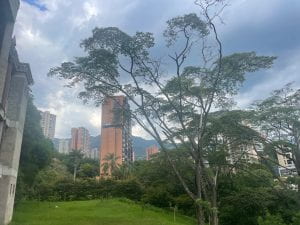
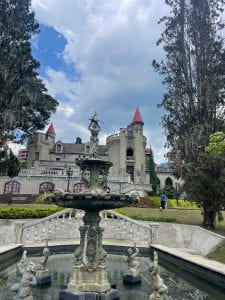
During my first week, I started off by visiting a castle and gardens in the luxurious El Poblado district, known as the commercial center of the city. It was once the house of the physician José Tobón Uribe until 1943 when industrialist Diego Echavarría Misas bought the house for his family. The inside of the castle contained beautiful antiques, paintings, and sculptures and there were panoramic views of the city from the windows. After my visit to the castle, I walked down a hill to the main square and explored the neighborhood. El Poblado was all very manicured—leafy boulevards, shiny malls, lavishly-decorated cafes and hotels. Though, I was told by locals that this did not represent the “real” Medellin—at least, not the city that the majority of the residents lived in.
 

Comuna 13 


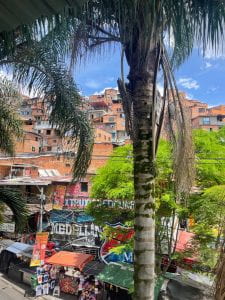
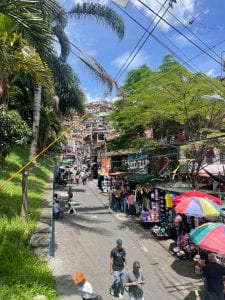
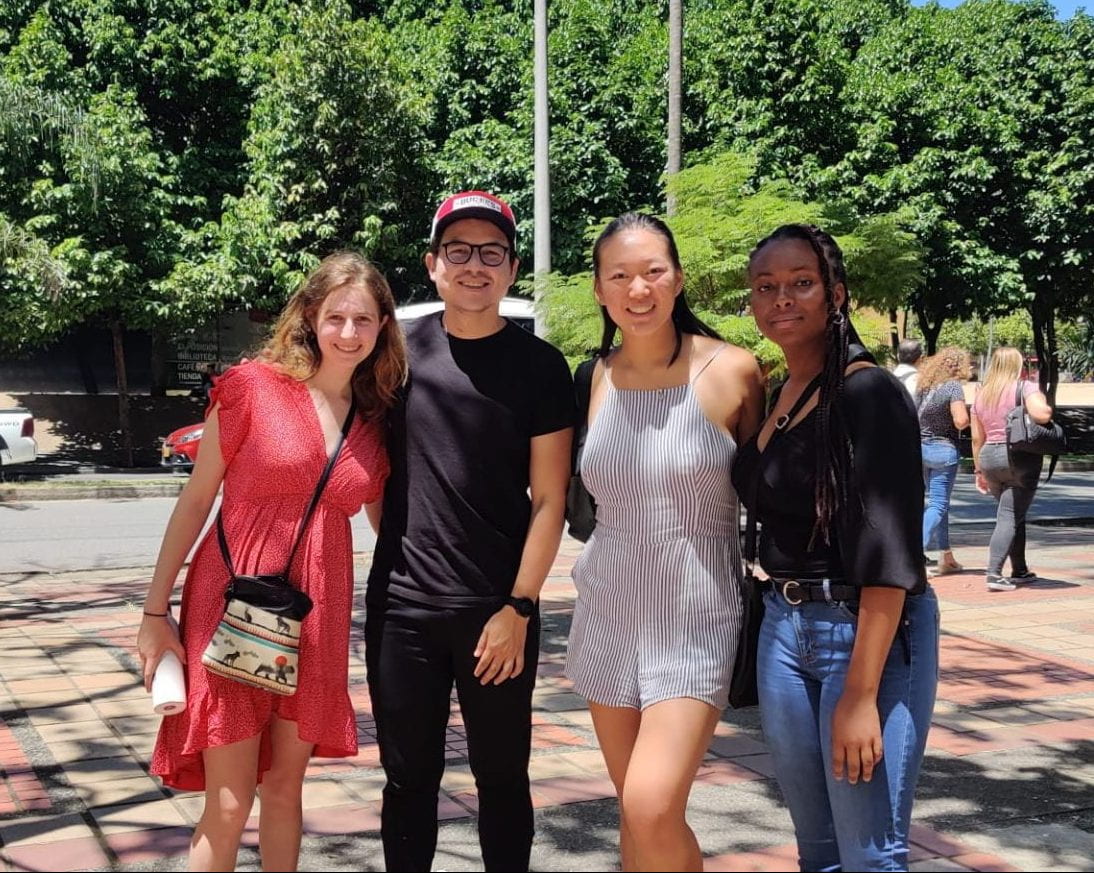
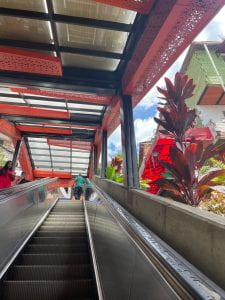
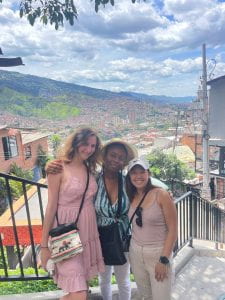
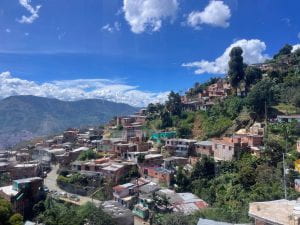
I began to venture more outside of the wealthiest districts of the city. For instance, a couple of my fellow Rice students and I visited Comuna 13, a historically low-income, informal settlement that was originally occupied by rural migrants who had been displaced from their homes. The neighborhood’s residents were often caught in the crossfire between gangs, drug trafficking organizations, guerillas, and paramilitary groups. In the last 20 years, a government-sponsored re-development project and the construction of outdoor escalators has transformed the neighborhood into a safe tourist attraction with very little violence. Today, thousands of people visit Comuna 13 each day to view its colorful graffiti art, which was created by local artists as symbols of hope and resilience in the community. However, one could say that Comuna 13 is no longer the “real” Medellin either—as it is now overrun by souvenir shops and foreign visitors. There is also an argument to be made that the increasing tourism makes the residents of the neighborhood a spectacle—though it has also provided a large boon to the economy, promoting local businesses and the creation of jobs.


MetroCable 

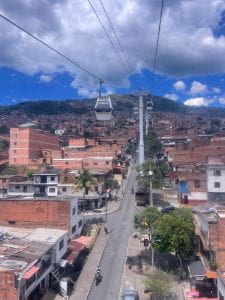
Another memorable experience I’ve had so far is riding the Medellin Metro Cable, a public transportation service and gondola lift system. It was designed to connect low-income communities on the city’s steep hills to the Valley of Aburra, which includes the city center. Before the invention of the Metro Cable, some hillside residents in communities such as Santo Domingo spent nearly 3 hours commuting to work because of the lack of a convenient bus system. When the service began its operations in 2004, the Metro Cable improved the mobility of residents of mountainside communities and massively shortened their commutes to work. Many studies attribute the gondolas to reductions in crime and an increase in economic prosperity in areas near the MetroCable.


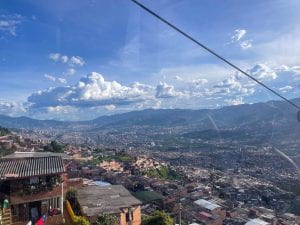
There are also spectacular views from the gondolas. From the last stop at Santo Domingo, I was able to see large parts of the city and the Andes mountains in the distance. I also enjoyed being able to look down and see houses, streets, basketball courts, food vendors, and graffiti. It was like getting a little slice of life from a bird’s eye view.


Bike Tour

A couple weeks ago, I decided to sign up for a 4-hour bike tour. It was a chaotic and strenuous ride—but, ultimately, it was incredibly rewarding. First, we biked up Cerro Nutibara, a steep hill in the middle of the city, that left me exhausted and out of breath. Luckily, there was a refreshing coconut drink once we got to the top.

One of my favorite parts of the tour was biking through Downtown, which was a surreal experience, since it was packed to the brim with people. Trying to bike through large crowds, motorcycles, cars, and street vendors was definitely a challenge, though it was a great way to experience the vibrance of the city center. We stopped right outside the main train station for a Colombian snack, and I got to eat this delicious arepa de chocolo, which is basically a fried corn tortilla with cheese on top.

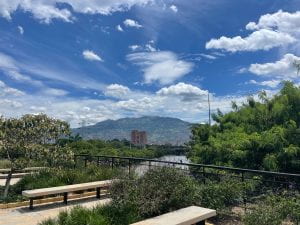
Throughout the tour, I learned a lot about Medellin’s status as one of the world’s most innovative cities that has set many milestones for sustainable design and equitable urban planning in the last 25 years. Recently, miles of cycling lanes were added to streets across the city, including in both low-income and high-income areas. Medellin has also introduced a new initiative called ciclovia, in which they close one of the major roads, Avenida Poblado, on Sundays and open the street up entirely to pedestrians, bikers, and even roller skaters.


Conclusion 

It was interesting to see how perhaps Houston had much to learn from Medellin in terms of public transportation, infrastructure, and sustainable design. Medellin certainly still has a long way to go; in my experience, the bike infrastructure was not perfect—sometimes I was on the road with cars and a few times I had to swerve to avoid potholes—but I would say that it was still better than my biking experience in Houston.

Furthermore, while Medellin still has a significant amount of inequality, it was truly fascinating to see the transformation that the city has undergone only in the last couple decades. The MetroCable and the outdoor escalators, in particular, were some of the best examples of creative and equity-focused public transportation, and were both pretty incredible to witness in-person.
Halfway Done, Reflecting on my time here in Medellin, Colombia

June 26th, 2023 by Mikayla

As of writing this, I have just completed my fifth week here in Medellin, Colombia. This experience was transformative, as I have seen remarkable changes within myself. The city itself is vibrant and full of life, with a rich history and culture that I have been eager to explore through museums, events, and restaurants. Of course, some challenges come with living in any new place—language barriers, cultural differences, and navigating unfamiliar streets—that can be daunting at times. But overall, I feel incredibly grateful for this opportunity to immerse myself in a new culture and way of life.

Since this is the first time I have traveled outside the United States without family and the primary language is not English, these stressors caused some pre-travel jitters. For weeks leading up to my flight, I tried to appease my nerves by teaching myself as much about the country as possible before my trip. (This comes from my mother, as we both, or at least try to, overprepare for anything.) I researched everything about the country, the city, and the specific neighborhood that I would be living in for the summer through the internet, social media, and talking to family, friends, and other people who had visited Colombia before. I also listened to more media in Spanish in hopes of easing the transition from primarily speaking English to Spanish outside my house. The measures taken helped me, but they failed to prevent the cumulation of these anxieties and more.

One of the anxieties I struggled with was switching dominant languages. Coming from a monolingual household, I struggled with accepting that no one in my family could help me with this mandatory switch. However, I did my best to prepare for it myself. Despite this, I have experienced some challenges. Some of my speaking anxiety stemmed from my limited vocabulary and not-so-perfect grammar. The limited vocabulary could be fixed by speaking more and learning slang and colloquialisms. However, grammatical issues could only be fixed through practice in speech. At first, my speaking anxiety prevented me from speaking freely. However, I was pleasantly surprised by how understanding people were of my speech. When I could clearly communicate, I marked those times as a little win for myself. Of course, there were times that I accidentally mispronounced a word and/or said a similar-sounding word with a completely different meaning. However, even during those times, the person I was talking to was usually empathetic and spoke clearly so that I could understand.

Though having an empathetic listener is normally the case, this will not always be the case. There would be times when a stutter, hesitation, or even my accent hinted to another person that Spanish wasn’t my primary language. Because of this, the other person would automatically switch to English if they knew, or act annoyed and stop talking to me altogether. For example, during my third week here, I took the wrong bus. It traveled to the downtown area of the city, which is in the opposite direction from where my apartment is located. When I noticed this, I attempted to talk to the bus driver, mentioning my concern about my current location and if the bus would go to my apartment or at least return to the station I entered from. However, the driver started shouting. In the noisy environment, I was unable to completely comprehend what the driver was saying. After two minutes of trying to understand what he was saying, he went quiet and ignored me. (I was eventually informed by a lady on the bus that if I continued sitting on the bus, it would return me to my intended location.)
In either case, I would feel a mix of emotions. I would start to second-guess myself, feel self-conscious about my skills, and begin to clam up. However, soon after those events, I would have to continue forward and push these negative feelings behind me instead of wallowing. These good and bad speaking experiences serve as learning experiences, and I realized early on that I could not just take the good without the bad. To see true progression, I had to embrace my flaws and strengths simultaneously.

Learning that lesson liberated me from the feeling of trying to speak perfect Spanish. Free from that suffocating feeling, I could work to improve myself through everyday conversations with my co-workers and passersby. Through fully embracing this immersive experience, I have gained a more adventurous and confident stature. Now, if there are events I would like to go to, I would go, not allowing my prior anxieties to continue dictating my decisions. I want to take a stroll around the neighborhood. Why not? I want to go to the local theater to watch a new movie. Sure, who is stopping me? (Of course, I would have to consider safety precautions as a solo traveler in these situations.) Contrary to my previous sentiment, which would constantly impede my personal exploration, this new way of thinking allows me to truly enjoy my time here.

Cable Car Experience

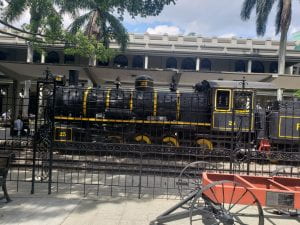
Last Train in Medellin

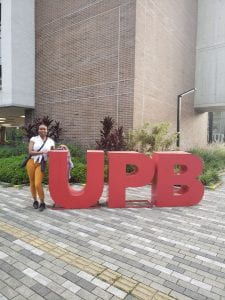
Visiting local universities: UPB

Now that I’m at the halfway point, reflecting on my progression since coming here has served as a great reminder of my personal and professional development. As I look forward to my future weeks here, I plan to keep an open mind and embrace every moment.

Meeting Dr. Cesar Uribe

Che, ¿qué tal te va? – Cruz Roja Argentina, Buenos Aires, Argentina – Loewenstern Fellowship

June 26th, 2023 by Jorge Luis Arnez Gonzales

A day after finishing my last final for the semester and packing all my stuff frantically to move back on-campus, I was on an airplane to Buenos Aires, Argentina. Somehow, it has now been 7 weeks since I have arrived in Buenos Aires, and I have learned a lot about the work I want to do in the future and myself. Furthermore, I am extremely grateful for the people I have met during my time here and still cannot believe that by the end of next week I will be saying farewell. Although I cannot write about everything that has happened so far, since it would take forever, I am happy to share the following highlights.

Cruz Roja Argentina – Filial Vicente Lopez and Filial Villa Crespo

From the moment I looked at the list of community partners for the 2023 Loewenstern Fellowship, I had my eyes on the Argentinian Red Cross. Having learned about its origins and the impact the organization had in regards to international human rights, I was excited to be an intern in the organization. I could have never imagined, however, the reach and types of activities, programs, and workshops organized by the Red Cross. I have worked in up to three Red Cross filiales (subsidiaries) in different locations across Buenos Aires, but have mainly stayed in Filial Villa Crespo and Filial Vicente Lopez.

Scouting Event – Patrolling the area to check if there was anybody injured and needed to be taken to the Red Cross’s tent

In filial Villa Crespo, I mainly completed the Red Cross’s first aid course, which is a requirement to participate in more complex projects. Thanks to my background in EMS through Rice EMS, a good portion of the course content was review. However, I did learn some important skills, including techniques not taught in the Rice EMS course and how to best be of assistance to people who suffer an accident without having immediate access to medical equipment or medications. Furthermore, it was through this course that I was able to make the most amount of friends and meaningful connections here in Buenos Aires.

Work:

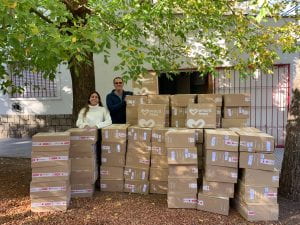
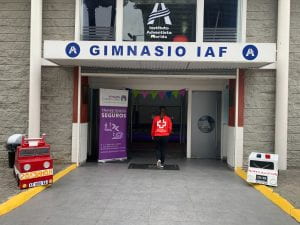
In filial Vicente Lopez, I have had the opportunity to be involved in everything ranging from administrative work to blood drives to community health initiatives. The first activity I was involved in was working with other volunteers to provide first aid assistance at a scouting event which had about 100 kids and teens. Not only did the event take place in a beautiful green area near the coast, but the volunteering team was wonderful overall. I was able to assist with taking down information of people who got injured and walking around the area searching for people who needed our assistance but could not physically move to our tent. Since that activity, however, I have done several more. The one that surprised me the most actually happened just last week, where I helped in delivering a road safety workshop to high school students and basic wound care to toddlers. We were able to use very interesting equipment that simulated one’s eyesight under the influence of alcohol, illegal drugs, and when one is extremely exhausted to show high school students the dangers of driving under the influence. Furthermore, we also taught toddlers how to best help out their friends if they see a small bleed or scrape. The activity with the toddlers was particularly interesting since I would have never imagined the children would retain anything of what we were telling them. To my surprise, after our talk, most were able to show us how to apply direct pressure to a wound to stop the bleeding and how to dress the wound with gauze. On the administrative side, I have helped with document classification, destroying old documents that are no longer needed, and logistical tasks like helping in receiving CPR training equipment. This wide range of tasks has allowed me to see all the different ways in which a non-governmental organization operates, ranging from the hands-on community work all the way to more monotonous but necessary desk work.

CPR Equipment – Red Cross acquired over 50 new CPR training mannequins for first-aid training

Road Safety Workshop – We gave a wound-care workshop to toddlers in celebration of road safety day

Tourism:

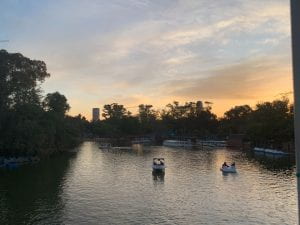
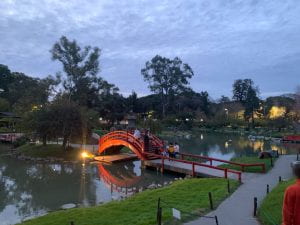
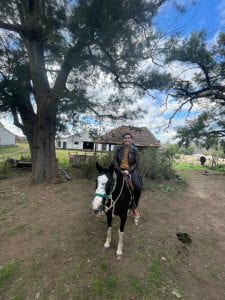
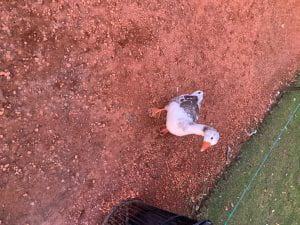
Buenos Aires has a lot of tourist attractions that are popular to foreigners and locals. Although I have resigned myself to not being able to visit all of them (without mentioning the ridiculous amount of things one can do in other parts of Argentina), I have quite enjoyed visiting several of these attractions. My favorite so far has been going to the Rose Garden and the Parque 3 de Febrero, both areas filled with greenery, pleasant smells, and tons of ducks (see attached picture of Don Pato). I got lucky enough to go during a day where the sky was clear and during sunset, so I was able to enjoy my own company next to the small lakes and ducks while eating chocolate. What was the most mesmerizing thing, though, was that the park and rose garden were located right next to the hectic highway and city, providing refuge from the urban chaos. On the topic of nature, I was delighted to have gone to a town away from Buenos Aires called Santiago de Areco where my travel partner Valeria. We got to horseback ride, explore nature, and try some delicious steak.

Parque 3 de Febrero at Sunset


Japanese Garden

Socializing

Socializing was definitely an uphill battle for me. Although this is not the first time I am far away from home, it is the first time I am leaving home to work rather than to study. As a student, whether at a summer program or college, socializing would be easier because there would be common spaces (classes, office hours, clubs, etc.) where I could meet people. This time, however, the situation was completely different. Because a lot of the work the Red Cross does is thanks to volunteers, the staff and people involved in every activity changes all the time. In other words, other than the supervisor, I was meeting new people constantly. While this initially seemed like an opportunity to create more long-lasting friendships, I realized that meeting a person once for 4 hours at most does not really allow me to make a lot of connections. Nonetheless, thanks to the first aid course I took and going out of my way to be more extroverted, I have been able to form some friendships and connect with people. Furthemore, I have become more capable of enjoying my own company and finding peace in being with myself.

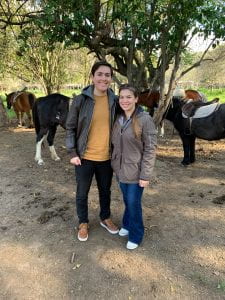
Santiago de Areco – Post Horseback Riding

Horseback Riding in Santiago de Areco

Challenges:

Like every experience, there were some challenges I could not have prepared myself for during my trip to Buenos Aires. For one, my identity as Bolivian was challenged through microaggressions with more frequency that I would have liked. Because I grew up speaking English at school and speaking Spanish everywhere else in my life, my accent is not easily identified as Bolivian. I have been asked if I was from Ecuador, the U.S, some place in Europe, and Costa Rica. While these comments are not ill-intentioned themselves and not problematic themselves, the tone with which people reply when I say I am Bolivian often strikes me as weird to say the least, since some locals will respond “but you don’t sound Bolivian” in a tone that hints at it being something positive. This has led me to have somewhat of an identity crisis. My English is not “perfect” enough to blend in when I am in the U.S and now my Spanish does not sound Bolivian enough. Nonetheless, as I continue to do some introspection, I realize that I do not have to fit any mold to be Bolivian. I feel comfortable in my identity and I do not owe explanations to anybody.

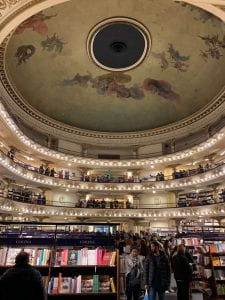
El Ateneo – Very similar to Barnes and Nobles but way more artistic

Don Pato 😀

Final Thoughts

My experience with the Red Cross has been overall wonderful. This experience has reinforced my goal of helping underserved communities through population-level initiatives that promote prevention and effective bystander intervention.

how i learned not to quit in quito

June 26th, 2023 by sam lee

hello everyone! since i’m writing this ~2wks out from the conclusion of my program, i figured i’d talk about some of my overall takeaways from my loewenstern experience. i’ve been here for a little over 5 wks and it’s definitely felt both so short and so so long. i’ve thrown some pictures at the bottom but you’ll have to get through my blob of text first.

arriving in quito, ecuador, i struggled a lot my first week. it wasn’t my first time in a latin-american country and i’ve definitely lived in some low-resource settings before but it was still hard to feel like i was prepared for my time here. even after adjusting to daily living conditions, the crazy weather (hail, rain, sun… all w/in the same hour), the dangerous political climate (cartels, political riots), and accessibility problems (sun sets early, roads aren’t v pedestrian friendly, street crime rates are high, etc) overwhelmed me. i often ended up trapped home alone (w/ Christina) after work, too nervous to go out and not knowing how to get around. to make matters worse, on my first courageous attempt to explore our neighborhood, a rabid(?) dog chased me and bit me, leading to a midnight emergency room visit, many phone calls w/ ISOS (who i’ve been so grateful for), and eventually a quick getaway vacation to miami to receive medical treatment that wasn’t available in Ecuador.

spending my first half of wk2 locked up in the hotel room or the hospital, i don’t think i was as excited for my loewenstern experience as i’d been a few months prior. even so, i told myself it could only get better and hopped back on the flight. and it did get better. as the wks went by, we got closer to the people we worked with – we got to meet others our age and hung out with them socially outside work a few times. we had an open/serious conversation with our point person from the org (who we are also neighbors with) about how difficult the adjustment had been and she did her best to help us out – she’d drop off food from time to time, or invite her to hang out w/ her and her daughter, and we’ve also visited some cool places around Quito that only a local could show us. apart from her, i’ve come to enjoy getting to know other members of the organization and i’m happy to say that my Spanish has grown along with my friends. don’t get the wrong idea though – i still have plenty of moments where conversations stump me or i have to ask others to repeat themselves. also i’ve realized that Asians are not a common sight in these parts and as a result all of the children at the schools (we work at schools btw) swarm me for autographs, photos, and random requests for Korean translations. i’ve learned to interpret what can be considered rude or microaggressive as curiosity and lack of exposure (and i’ve explained how to say “hello” in Korean so many times that even Christina could teach it perfectly by now). it’s hard not to feel lonely or homesick esp in a strange new place, but things have gotten better as i’ve grown more familiar with the region but also developed a social support system with those around me.

outside of work, i’ve become more familiar with the area and have been able to venture out pretty regularly for errands and mini excursions. the food here is great (im not that picky about food so it’s easy to please me) and we’ve had the chance to eat all sorts of new things (i have my conscience tho… so i’ve avoided ice cream w/ cheese and guinea pig at all costs). even if i’m not out and about, i’ve learned to enjoy my time at home; i’ve used my extra time to read tons of books (i’m happy to recommend some), do some self-learning about things i’ve always put off, and relax (catching up on tv shows or simply laying in bed and listening to music/podcasts). as the weather’s shifted from rain to sun, i’ve put my trauma to the test and gone out running on a trail nearby and can say that (1) running is a part of my daily life now and (2) i don’t even flinch when dogs bark/run towards me.

bottomline, i’ve developed all sorts of skills in my time here: working w/ kids, working w/ teachers, critical communication, Spanish, research, project management, leadership, navigating foreign medical systems, ordering taxis, bartering for items in street markets, running rly fast (the doctor’s advice when i asked him how to avoid dog bites). more than “skills” i feel like i’ve grown as an individual, learning to be more mature and independent and resourceful. i’m grateful for the foods that i’ve eaten, the places i’ve seen, and the people i’ve met.

for those of you who’ve just started your fellowship, don’t give up if it gets difficult and know that it’ll be better! for those who are going strong, good for you and i hope you enjoy every last minute of it. thanks for reading and below are some photos.

me standing on the equator

quito skyline at night

naranjilla ice cream. we eat ice cream at least once a day and they hve so many unique flavors

writing in korean for some very insistent students…

A Day in the Life and More: Banco de Alimentos in Cochabamba, Bolivia

June 20th, 2023 by sec17

Since May 19th, Sowmya and I have had the opportunity to work at the Banco de Alimentos in Cochabamba, Bolivia. Going into this experience, I had no idea what to expect. I had very little experience travelling, and I’d never been to Latin America. We’re now starting our 5th week here, and although I still have a lot of learning and growing to do, I feel like I’ve adjusted and found a nice rhythm. I have so much love for the food bank, everyone I’ve met here, and the city of Cochabamba as a whole. So I’m going to try to share a little bit about what makes this place so great and walk you through a day in the life. To start off, here are some pics of the city.

Cochabamba!

Cristo!

The views from a hike we did a few weeks back

A Day in the Life:

I wake up between 6am and 7:30am every morning, depending on whether it’s a garbage day. I honestly have to say, the biggest culture shock for me was the garbage trucks. They sing to you when they come by, three days a week, letting you know that it is time to take out the garbage. Sowmya and I got very lucky, because we happen to live in a neighborhood at the start of the truck’s route, so we get to hear the music at 6am. It hits the food bank where we work around 10am. Honestly, I’ve grown to kind of enjoy it. After that, I make myself breakfast (usually oatmeal), and chill for a bit until we get picked up between 8:30 and 9am. Here’s the view from our apartment.

We usually get to work around 9am. Sowmya and I work in different departments, and we switch off every 2 weeks. For the first two weeks, I worked in logistics and Sowmya worked in beneficiaries. Now, we do the opposite. We either get orders ready to be picked up by beneficiaries, or do some office girlie stuff with spreadsheets and communicate with beneficiaries, making sure all of their orders are correct.

me in the warehouse after the powdered milk delivery

me in the warehouse doing warehouse things (safely)

We eat lunch at 1pm every day. We set up two big tables and all sit around it and talk and hang out for an hour. I feel like I get to try a new food every single lunch hour. 

After lunch, we get back to work. Each day is different, but on some days we get to take the big truck (camionzote) to drop off food at beneficiary locations or go to warehouses and pick up donations from businesses. Occasionally, we get to go to the food bank’s hydroponics farm and harvest lettuce (which is one of my favorite activities because I think hydroponics are so cool).

hydroponics right before harvest

Also, sometimes we get to visit some of the beneficiaries of the food bank. Most recently, we brought some bones over to Alba Esperanza Animal Sanctuary, which is where we donate food that is past its expiration date or, for some other reason, can’t be redistributed to organizations that serve humans. Here’s some of the beneficiaries we met there:

vaca asf

just a few of the 75 dogs at Alba

We usually get home around 6:30 or 7pm. After that, I rest up or go to the gym, make some dinner, watch some TV on an extremely legal website because Netflix ended password sharing, do some household chores, and pass out in my bed. And that’s a day in the life.

Food:

Working at the food bank, I’ve learned a lot about food and had the chance to try so many new things. Some of my favorites include siete sabores, a fruit I tried recently that tastes like a combination of seven different citrus fruits, buñuelos, which are delicious fried dough you can find on the street here for around 15 cents, and pique macho, a traditional Bolivian meal with various meats, eggs, tomatoes, and sauces. I also really love the cheese empanadas here. They are made from this delicious fried dough, filled with cheese, and dusted with powdered sugar. And finally, salteñas, which are baked pastries filled with meaty soup.  We got these on our first day in Bolivia, and they’re now one of my favorite foods. If you ever get the chance to come to Cochabamba, get ready to eat a lottttt of food.

maracuya ice cream with some cheese empanadas

siete sabores!

salteñas

marshmellow

I’ve been trying something new nearly every day here, but Cochabamba is the food capital of Bolivia, and there are still an overwhelming number of foods I haven’t tried yet. And I can’t wait.

Challenges:

Although everyone at the food bank has been incredibly welcoming and kind, there have also been some tough moments. For one, like Alex, I was very overconfident with my eating habits, trying everything I could get my hands on without a second thought. It didn’t hit me until around my 3rd week, when I was out of work for four days with some serious food poisoning. Although, on the bright side, getting food poisoning gave me an introduction to the Bolivian healthcare/medical system, which was honestly amazing. Medicine is so accessible and cheap here, and my doctor was incredible. The US has a lot to learn.

Also, like any good intern, I make so many mistakes. I think I mess something up at work about every other day, whether it be miscounting items for a pickup, or printing the wrong numbers on receipts, or spilling soup all over myself and the entire lunch table. My supervisors are always super understanding and kind about it, but it is always super embarrassing. Still, I’m hoping for fewer mistakes in my next 5 weeks here. Also, it’s been a bit difficult to balance work and activities outside of work. Sowmya and I work six days a week from 9am to 6:30-7pm. I’ve learned that I have to be very intentional about my time outside of work, making sure to allot time to prioritize my mental and physical wellbeing, fun, sleep, and work I have to get done for school. I’m still struggling with this, and I have put off a lot of the work I need to get done before the end of summer, so if anyone has time management tips I’m all ears. 

All things considered, this has been such a unique and wonderful experience thus far. I think I’ve learned more in the past 5 weeks than a whole semester of college, and adapting to life in Cochabamba has been so rewarding. Everyone at the food bank cares so much about what they do and about each other, and I’m so glad to have the opportunity to be a part of all of it. I’m so thankful to my colleagues at the food bank for immediately treating us like family, Kelsey for being there every step of the way, Sowmya for supporting me even at my worst moments, and to Jorge for introducing Rice to the Banco de Alimentos and making all of this possible. So much love.  

Anyway, until next time! And safe travels to everyone.

Summer 2023 Loewenstern Experiences: San Cristóbal de las Casas Edition

June 14th, 2023 by Alexander Cho

Hey there, everyone. Somehow, it’s already my sixth week in San Cristóbal de las Casas. To echo previous bloggers’ sentiments, it’s a little startling how quickly the weeks blew past. Honestly, I haven’t taken a lot of time to reflect on much until now. There’s too much I want to write about to fit in one blog, but I hope I can still provide a glimpse into my time abroad in Mexico under the Loewenstern program, along with highlights of what I’ve learned and experienced these past few weeks. ¿Mi chapalot xa?

Ecology

The ecology in Chiapas has been exciting to watch! The hardest part has been taking pictures of critters without their scattering, flying away, hiding behind tree branches, or shifting at the most inopportune times. Even after I would give up taking pictures of them, I’m not well-versed enough to be able to identify as many of them as I would like to. Still, it’s thrilling to see a new animal show up for me to admire. I saw hummingbirds that zip past our window from time to time. I saw lizards and moths of all sorts of sizes and colors. There were also several daddy-long-legs in my bathroom, which was fun to discover while I was showering.

There’s a natural overlap between the flora and fauna of Houston and Chiapas, even as far south as we are. I got to see plenty of familiar monarch butterflies and prickly pear cacti. Even so, there were plenty of other new faces like the white-throated magpie jay (Calocitta formosa) and Bocourt’s emerald lizard (Sceloporus smaragdinus). I even got to see a white-nosed coatí (Nasua narica) at Las Cascadas de Chiflón! 


White-nosed coatí. If you get a microscope, I bet you’d almost be able to see it in the picture. The other shots were even worse than this one, funnily enough.

Milkweed. A familiar sight back in Texas.

Dead moth I found on the sidewalk  🙁 Its wing was torn, and I don’t know what species it is. Still neat to see.

Sceloporus smaragdinus. Funny little guy who ran away from the camera.

Weird looking flowers. Very pretty! I wish I knew the name of it.

We were greeted by this monkey fella at Las Cascadas de Chiflón. Very vigilant looking.

We even found aliens in a cave!

Challenges

¡Provecho!

Breaking out of my comfort zone was a big personal goal of mine coming into this trip. To this end, I’ve been spending a lot of time doing just that–intentionally and unintentionally. When I first arrived in Mexico, I was only fairly confident in my ability to speak Spanish, and that was my main concern initially. I quickly realized, however, that the true challenge was figuring out how to work in a kitchen with a total of one knife and dubious tap water. I barely know how to cook in general, so this was a trial by fire that I threw myself into with varying levels of success. But now we have a microwave and actual knives, so things are on the up and up. 


My first attempt at cooking in Mexico went quite poorly. Surprisingly, beans don’t taste that great when they’re crunchy and unseasoned.

호박전. I expected to miss homemade Korean food, but it got pretty bad around Week 4. This is the result of my coping and it came out well enough for me to feel better.

Lentil rice. A lot tastier than how I thought it’d turn out. Shoutout to Yeung Man Cooking on YouTube.

First time I’ve tried meal prepping. It’s honestly fun, but I need to work on not making a mess on every surface imaginable.


Other parts of life in San Cristóbal haven’t been easy. Most travel blogs I’ve read have advised preparing for digestive issues while in Mexico, but I did not expect it to hit me basically immediately. To avoid providing any overly specific details, let’s say I overestimated my digestive tract on Week 1. That’s been a fun ride, and I still can’t look at mushrooms for the time being. So word of advice for any travelers as overconfident as I was: buy some stomach medicine and BRAT foods as soon as you arrive.


Caldo tlapeño–the most likely culprit of my almost immediate traveler’s diarrhea. A huitlacoche pizza became the scapegoat, but I think it was framed.

Others agreed more with my stomach. Mole enchiladas rock.


Some more unsolicited advice: be careful with your credit card. Honestly, I think this is mostly just bad luck on my end, but I managed to use my card around three or four times before someone tried spending 1000 pesos with it. (The transaction name said it was for some fantasy sports betting site? If that’s the case, I hope the bets worked out for the dude so that it wouldn’t be a complete waste). In any case, San Cris is a very cash-friendly town. Outside of large and cumbersome transactions like groceries at a supermarket, I’ve been able to use regular pesos for most of my purchases. So it’s not as bad as I might be making it sound by complaining for a whole paragraph!

Language Concerns

Experience with Spanish

Using Spanish daily is fun. I finally managed to remember (most of) the preterite conjugations, but it’s still hard to catch up in a conversation. I found that it’s hard for me to distinguish Spanish words from each other when someone’s speaking. While I was trying to find ways to improve, someone at a bar told me that when he practices English, he tries to think in English as well. Sounds like a brilliant idea. Why not try this out myself? It turns out that the main issues that I’ve come across are that I’m a little forgetful and that my head’s kind of empty a lot of the time. It’s a bit of a work in progress.

One goal I set for this trip was to improve my ability to listen in Spanish. While I definitely hear Spanish every day, after a bit more than a month, I don’t feel a notable improvement in the words I can make out in a conversation. Combine this with a variety of outside conversations or the rattling of outside traffic in a colectivo, and it almost feels like I’m fighting for my life out there. Still, it’s been a great opportunity to practice in a trial-by-fire sort of way, and I’m looking forward to doing just as much for the rest of my trip. Who knows? Maybe I’ll wake up one morning and have shed all my knowledge of the English language. (Like a snake or something. Is that how that works?) 

Experience with Tsotsil

So with all of these concerns in mind, I decided to take Tsotsil language classes! Tsotsil is an indigenous Mayan language that’s frequently spoken in San Cristóbal. You may wonder what this has to do with improving my Spanish skills, and the truth is that I don’t know either. But it’s been a lot of fun learning some basic phrases and grammar. There’s a lot of cool challenges with the pronunciation; it’s very different to any other language I’ve learned, and yet it’s also quite similar to Spanish. It definitely intrigues me in how the Spanish and indigenous Mesoamerican languages have influenced each other.

The vocabulary itself has also been challenging because of all the different regional variants within the language. For example, my teacher is teaching the variant spoken in Zinacantán, a town to the west of San Cris. On the other hand, one of the workers at Cántaro Azul speaks the variant from San Juan Chamula. Despite the towns’ being only about a 15 minute drive from each other, the vocabulary is surprisingly different! In fact, I’ve learned that there’s a lot of different ways to say “How are you” among the Tsotsil variants. The Zinacantán variant is “K’u xa-elan,” but the Chamula variant is “K’uxi avo’onton?” Dictionaries online usually do not make note of any specific, and some resources I’ve been using say that they get their vocabulary mainly from friends and vendors around San Cris. So who knows what sort of mixture of Tsotsil that I’m learning? You won’t hear me complain, though. It’s been a fascinating ride.

Anyway, I’m hoping that by the end of my time in Mexico, I’ll have at least some of the basics down. Somehow, I don’t have high hopes that I’ll get many opportunities to use it at all back in the United States, but it’s been good in the meantime. 

Mangos with the Cántaro Azul team. They’re awesome people.

This trip, I’m extremely grateful for my Loewenstern partner, Shivani. Without her, I wouldn’t have any idea of what is happening in the city or what restaurants have been vouched for. She’s very in-the-know about things! I admit that it’s difficult for me to socialize, especially in a new language. However, I’m hoping that as I turn over to the second half of my time in Mexico, I’ll take more proactive measures to find even more new experiences and continue to kick down my comfort zone. See you later/Hasta luego/Jlikel to!

Finding Community While Abroad: San Cristobal de las Casas, Chiapas, Mexico

June 8th, 2023 by Shivani Gollapudi

This week will be the start of my fifth week in San Cris. As of now, I’m feeling pretty settled, and I’m excited for the next few weeks to come. I also cannot believe time has gone by this fast. Looking back, as I was planning my trip in the spring, one of the main things I was concerned about was how I would find community. I would be traveling to a new country where everyone speaks a different language that I do not have fluency in. But since I’ve arrived here, I’ve found a lot of different opportunities to meet people – students, travelers, and locals. In this blog post I hope to share some of the experiences I’ve had so far during my time in San Cris with the people I’ve met.

Exploring the area with fellow Rice students

My Loewenstern partner and I were lucky enough that the times we planned the trips coincided with a Rice study abroad program  led by Dr. Lloyo and Dr. Hunter that was also going to spend most of May in San Cristobal. It was really nice to have the company of the other Rice students, especially at the beginning of the trip when we were just settling in. Dinners with their groups and general hangouts have really made my time here in San Cris special.

Alex (my Loewenstern partner) and a few of the students from the engineering study abroad program at Parque El Encuentro

We spent some time exploring Real de Guadalupe (the main pedestrian street in the city with a lot of shops and restaurants).

Two weeks ago, we were also able to take a day trip to visit Cascadas el Chiflón y Lagunas de Montebello. We booked a trip with a travel agency that provided a tour van and guide. We left at 8 AM and drove about 3 hours to El Chiflón. We were able to hike up and see three waterfalls (so so beautiful!). Then we drove a couple more hours to a lake and spent some time kayaking. After that, we went to another lake that bordered Guatemala. We were able to walk a bit into Guatemala as well.  All in all, it was a really cool trip and a lot of fun to do with the other Rice students! I hope to do a few more day trips while I’m here.

The water was so blue!

We were able to kayak on this lake, and it was so beautiful.

I was standing in Guatemala!

The engineering study abroad ends this week, so the students will be heading back soon. I’ll miss having them around, but I’m so glad they were here at the same time as us and we got to meet!

Colleagues at Cantaro Azul

Everyone at Cantaro Azul, our host organization, has also been incredibly welcoming. From warmly greeting us every day to giving us restaurant and event recommendations, they’ve really helped us settle into the city. We’ve been spending most of our days working somewhat independently, but every morning we have breakfast together. Through my interactions with colleagues at Cantaro, I’ve realized that the hardest Spanish for me to understand is not the technical jargon –  most of the chemistry words are English cognates. It’s hardest to keep up when everyone is speaking conversationally. Nevertheless, I’m always grateful when they slow down to include us in the conversation, or inform us about certain cultural norms, such as greetings and other intricacies in Mexican Spanish.

This Monday, June 5, was Cantaro’s 17th anniversary. We ate a lot of cake together (Tres Leches is so so so so good), and it was really cool to see everyone in the organization come together to celebrate.

Classes/workshops

After my first day at work at Cantaro, I kind of freaked out at my lack of ability to understand conversational Spanish. That Monday evening I realized there was a Spanish school literally across the street from our Airbnb: Tu Mundo Spanish School. They offer a 5-day Spanish intensive (3 hours of class a day). During my classes, I learned a lot of grammar and also improved my conversational capability. But most importantly, my interactions with the instructors really smoothed my transition to San Cris. They told me about Facebook groups to join and events happening in the area. The Wednesday of my first week, they also have a little fiesta with tamales and traditional Chiapanese snacks and drinks. It was really great to meet the instructors and students, and we had a great time together!

Although my classes ended a few weeks ago, I’ve kept in touch with my instructors, and it’s been great to spend more time with them. Last Sunday, two of my instructors and another student (originally from Estonia) visited El Arcotete, a natural park about 20 minutes away from the city center. We grilled some veggies, corn, tortillas, and nopales, and had a really cute picnic on the mountainside. I think it was some of the best guacamole, pico de gallo, and salsa I’ve had. We hiked around the park after, and it was so beautiful. I wanted to paint it, so hopefully I can find some art supplies and take a painting trip to a natural park.

Friends from Tu Mundo!

Meal spread! All vegetarian 🙂

pretty view at Arcotete!

cave rock!

Salsa de tomates asados is so good.

Two weeks ago, I also started belly dancing (mainly because I realized there was a belly dancing studio also literally right across from my Airbnb). I could rave on and on about it. Our instructor is fantastic, it’s such a good workout but also a lot of fun and visually stunning (very pretty costumes!). It’s also been a great way to meet some other people. The class is pretty small – around 5-6 people, and it’s made of both locals as well as a few international people like me. I’ve loved the opportunity to get to know some of the other people taking the class, and we’ve had some great conversations before and after classes. And I may have discovered a new interest to perhaps continue in Houston.

Final Thoughts

The thought of moving to a new place without really having an established social circle has always been pretty scary to me. Through these past few weeks, I’ve learned that when I am in an unfamiliar place, it’s important to be incredibly intentional when forming relationships. In a college setting, I’ve found it much easier to meet people and form friendships — I’m in a setting with a lot of people similar to myself, and I’m constantly running into them. In San Cris, I’ve learned that I need to place myself in settings that are conducive to forming relationships – like classes and workshops. I also need to be more proactive and intentional about reaching out to people to make connections. I’ve learned that the city itself is pretty friendly. In general locals seem to somehow all be somewhat connected to each other (kind of like the vibe of a small town). There are also a lot of international travelers who have been pretty fun to meet as well.  But the energy put in is definitely worth it. Times where I’ve taken a chance or been more outgoing or friendly have resulted in some of my favorite and most memorable experiences in San Cris.

Life in Kenya

May 30th, 2023 by Roselyn Ovalle

A week before leaving Houston, it finally hit me that I was doing this. I was going to Kenya. I wondered how my days would play out, how much time I’d spend alone, and whether I would be able to form relationships with my host family given that I am just a stranger. However, within one week of being in Kenya, I can say that I have never felt more welcomed to a new place. I was immediately greeted with smiles and hugs by my host family. Every day we eat all of our meals together, help clean up together and share stories of our upbringing. At times I even forget I am in Kenya. I have come to appreciate the value of spending time with people and simply having conversations with them. It has made me realize that I should make more of an effort to share meals with my family once I return to the U.S.

Aside from Kenya’s comforting welcome, I have also gone through some uncomfortable or rather just new experiences. On my second day of work, we had to go from the office to our home using a matatu, a popular form of public transportation. But this isn’t a regular bus, the driver isn’t afraid of anything. We ride 2 inches away from cars, and go on the dirt road to pick up new passengers. It was scary at first, but now I am going back home in a matatu every day! It’s an adrenaline rush I didn’t know I needed after a long day of work. Also, did I mention that they are pimped out, by that I mean TV screens, 5-foot speakers, and celebrity portraits on the inside or outside of the taxi/bus. As of now the coolest one of been in, had Mariah Carey’s face on its roof. Excited to continue this routine and to become familiar with the roads of Nairobi!


P.S. Here is a picture of a matatu for reference